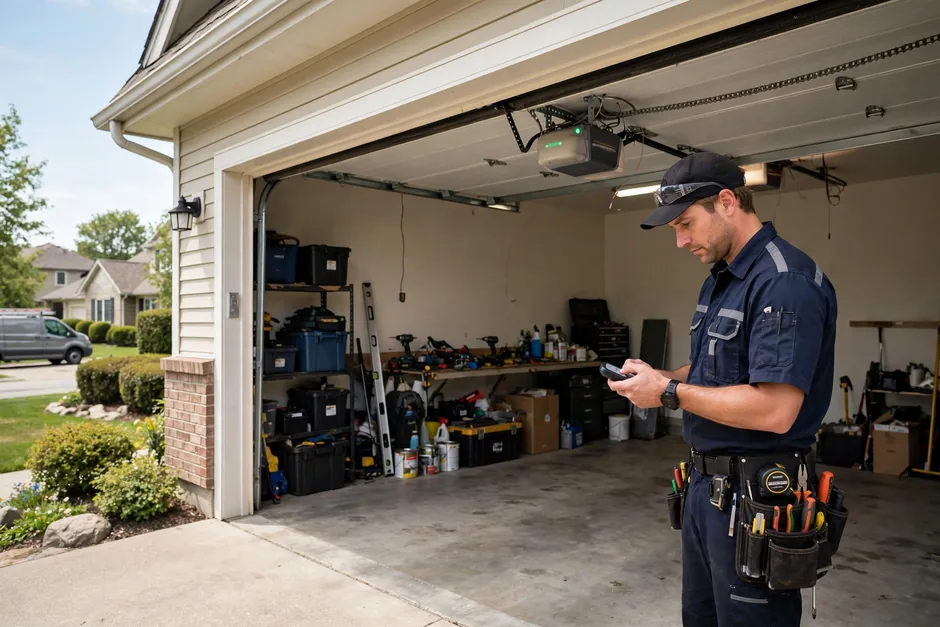
Most opener failures are not the opener. Across Hickory Hills and the surrounding 37122 neighborhoods, the wall button, the remote, the photo-eyes, and the door's springs each produce their own signature symptom. Match yours below before you touch a thing, and you will usually find the problem in minutes.
Match your symptom first
Technicians diagnose from the symptom outward. Find yours:
- Wall button works, remote does not. The problem is on the remote side: dead battery, lock mode engaged, or lost programming.
- Opener lights blink and the door reverses or will not close. The photo-eyes see an obstruction or are misaligned.
- Motor runs but the door does not move. The trolley is disengaged, usually from the emergency release cord being pulled.
- Motor hums and the door barely lifts, or will not lift. Likely a broken spring or cable. Stop and call a professional.
- Remote only works from a few feet away. Weak battery or radio interference. LED bulbs installed in the opener are a common culprit.
Remote and keypad problems
Start with the easy wins. Check whether the lock or vacation mode is engaged on the wall console; it disables all remotes and catches plenty of people after houseguests or power flickers. Replace the remote battery, then reprogram: press the learn button on the opener motor, then press the remote button within about 30 seconds.
Keypads deserve the same treatment, especially if you recently moved in. Clear the old codes first, then set your own PIN and sync it with the opener. If a remote works only at close range even with a fresh battery, try swapping any LED bulbs in the opener for opener-rated bulbs. Some LEDs emit radio interference on the opener's frequency and shrink its range to a few feet.
When the door will not close: photo-eyes
Every modern opener uses a pair of photo-eyes mounted near the floor on either side of the door. The beam between them must be unbroken for the door to close. When the opener's lights blink and the door reverses, the eyes are telling you something is wrong.
Both sensor LEDs should glow steady. Wipe the lenses, clear away cobwebs and debris, and check that the two sensors point directly at each other; even a small knock out of alignment breaks the beam. Sunlight hitting a sensor at certain hours can blind it, and humid months can cause false readings, so check alignment and cleanliness first in damp weather.
One quick diagnostic: press and hold the wall button. If the door closes while you hold it, the photo-eyes are the issue. If it still will not close, the problem is elsewhere. For persistent sensor trouble, see photo-eye sensor repair.
Motor runs but the door does not move
This one has a single usual cause: the emergency release. The red cord hanging from the opener's rail disengages the trolley so you can lift the door by hand during a power outage. If it gets pulled accidentally, the motor runs and the trolley slides without the door.
To re-engage, pull the cord back toward the door to reset the trolley, then run the opener once and let it reconnect. Now the critical safety check: lift the door by hand first. If it feels very heavy or will not stay open on its own, stop. That means the springs are not carrying the weight, which points to a broken spring, and a heavy manual door can fall without warning.
Force and travel limits: what we check on the job
Two settings govern how the opener moves the door. Travel limits set how far the door opens and closes; force settings set how hard the opener pushes and pulls before it decides something is wrong and reverses. When a door reverses just short of closing, or slams instead of easing down, these settings have usually drifted.
On a service call we test the auto-reverse with a 2x4 laid flat on the floor under the door, then set travel and force back to spec and retest. One piece of technician advice: if a door that worked fine for years suddenly needs its force cranked up, something mechanical changed. Find the cause, a binding roller, a tired spring, a shifting track, before you ask the opener to push harder. For anything beyond basic checks, see garage door opener repair.
When to stop and call a professional
Some symptoms mark the end of DIY. Stop and call if the door is too heavy to lift by hand, if cables look frayed or hang loose, if you see a visible gap in a torsion spring coil, or if the door sits crooked in its tracks. Springs and cables store serious energy and injure people every year.
We troubleshoot openers across Hickory Hills, Stonehollow, and the rest of Mount Juliet. If the door is stuck open or stuck shut, our 24/7 emergency line is the fastest way to reach us.
Get opener help in Hickory Hills
Worked through the guide and still stuck? Call (615) 616-0612 and describe the symptom. We will pick up the diagnosis where you left off.