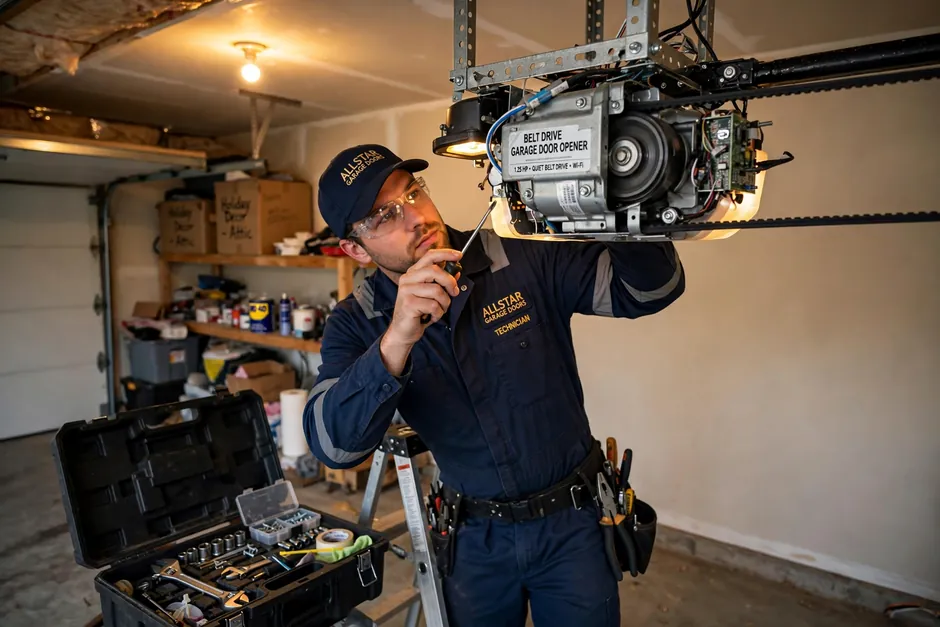
Full System Diagnosis
We run the door, watch the travel, test the balance with the trolley disconnected, and check wiring, remotes, and safety devices. You get the actual cause, not a guess, before any work starts.
We treat the opener and the door as one system. Most "opener problems" turn out to be a mix of opener settings, door balance, and safety devices, so we check all of it before touching a part.
We run the door, watch the travel, test the balance with the trolley disconnected, and check wiring, remotes, and safety devices. You get the actual cause, not a guess, before any work starts.
Chain, belt, screw, and direct-drive (jackshaft) units each fail differently. We service worn gears and sprockets, set belt tension, and correct travel-limit and force settings so the motor is not fighting the door.
Remotes, wall consoles, and keypads get reprogrammed or replaced. Photo-eye sensors get realigned and cleaned, and we verify the auto-reverse function actually stops and reverses the door on contact.
A stripped gear on an otherwise sound unit is a repair. A failing logic board on a 20-year-old opener with no parts support is a replacement conversation. We lay out both with real numbers.
Most repairs land between $129 and $399. You get a clear on-site quote before any work starts.
Call (615) 616-0612 and describe the symptom. We will tell you honestly whether it sounds like a quick fix or a bigger job.
Direct answer: A garage door opener is a motorized unit, usually ceiling-mounted, that moves the door along its tracks via a chain, belt, screw, or direct-drive mechanism. Repair means finding why that system is failing: worn drive parts, wrong force or travel-limit settings, bad wiring, dead remotes, or misaligned safety sensors, then fixing the root cause rather than the symptom.
Here is how we think about it on a job. The opener does not lift the door so much as guide it; the springs do the heavy lifting. If the springs are weak or broken, even a healthy opener will strain, hum, and quit. That is why the first thing we do is disconnect the trolley with the emergency release and lift the door by hand. A balanced door stays put at waist height. A door that slams down or rockets up has a spring problem, and no opener adjustment will fix that.
We service the common residential opener types found across Mount Juliet, including Chamberlain, LiftMaster, and Wayne Dalton units. For the full list, see our Brands We Work With page.
Drive types matter for both diagnosis and noise. Chain drives are durable and common in older installs around Willoughby Station and Hickory Hills, but the metal-on-metal chain is the loudest option, a real issue when a bedroom sits above the garage. Belt drives use a reinforced rubber belt and run noticeably quieter, which is why we see them in newer builds in Kelsey Glen and Providence. Screw drives have fewer moving parts but can be temperamental in temperature swings. Direct-drive (jackshaft) units mount beside the door instead of on the ceiling, a good fit for garages with high or obstructed ceilings.
If your door reverses for no reason or refuses to close while the opener light blinks, the problem is almost always the photo-eye safety sensors, not the motor. Model-specific programming steps for travel limits and remotes are published on the LiftMaster and Chamberlain support sites, and we follow those procedures rather than improvising.
A straightforward process. You will know what is wrong and what it costs before we pick up a wrench.
Describe the symptom
Call (615) 616-0612 or send the form below. Tell us what the door does: grinding, reversing, blinking light, dead remote. That tells us what to bring.
On-site diagnosis
We test the door balance, run the opener through full travel, and check sensors, wiring, and controls. Then we walk you through the cause in plain language.
Clear quote, then the fix
You approve a price before work starts. Most opener repairs land in the $129 to $399 range. Then we repair, adjust, or replace only what is actually failing.
Test everything
Full open and close cycles, auto-reverse check, remote and keypad range test. We leave when the whole system behaves, not just the part we touched.
Opener work is electrical and mechanical at once. Here is what is in the kit and why.
Multimeter
Checks the 24-volt control circuit, wall-console wiring, and whether the logic board is sending voltage to the motor. Tells us in minutes whether the fault is electrical or mechanical.
Socket set and nut drivers
For rail assembly bolts, opener mounting brackets, and sprocket or gear housing fasteners. Loose rail bolts are a common source of new rattles.
Level and tape measure
Verifies the opener rail is level and centered on the door. An opener pulling at an angle wears the trolley and strains the motor.
Ladder and headlamp
Ceiling-mounted units, wiring splices, and photo-eyes all live overhead or at floor level in poor light. You cannot diagnose what you cannot see.
Door balance test
Pull the emergency release, lift the door to waist height, let go. A balanced door holds. If it falls, the springs are weak and the opener has been doing the springs' job, which burns out motors and strips gears.
Travel-limit and force setup
Limits tell the opener where open and closed are; force settings tell it how hard to push. Set per the manufacturer's procedure. Too much force masks a binding door and defeats the safety reversal.
Photo-eye alignment
Both sensor LEDs must glow steady, not blink. We clean the lenses, align the pair across the opening, and confirm a blocked beam reverses a closing door, the behavior required on openers made since 1993.
Reversal test
A 2x4 laid flat under the door's path: the door must reverse on contact. If it does not, force settings or the logic board need attention before anything else.
Match your symptom to the likely cause. If yours is not here, call and describe it.
Symptom 01
Likely cause: dead remote battery, the opener's lock (vacation) mode engaged on the wall console, lost programming after a power outage, or interference from LED bulbs in the opener.
What we do: rule out the simple stuff first, then reprogram or replace the remote and check for interference sources.
Symptom 02
Likely cause: photo-eye sensors misaligned, dirty, or blocked. In humid months, condensation and cobwebs on the lenses cause false readings.
What we do: clean and realign the sensor pair, verify steady LEDs, and test the reversal. Often a 20-minute fix.
Symptom 03
Likely cause: the emergency release trolley is disengaged (motor runs, door still), or a broken spring or snapped cable has left the motor lifting dead weight (humming, barely moving).
What we do: re-engage the trolley if that is all it is. If the door is dead-weight heavy, stop using the opener and call us: running it will strip the gear or burn the motor.
Wilson County's climate and housing stock shape the failures we see. Hot, humid summers push moisture into older opener housings and corrode low-voltage wiring splices. Winter ice storms freeze the bottom seal to the concrete, so the opener strains against a stuck door on the first cold morning. And the March to May storm season brings the power flickers that wipe remote programming and, occasionally, logic boards.
Typical opener calls, what we found, and what fixed it.
Symptom on the left, what is actually happening on the right.
Problem
Grinding or clicking from the opener head, door stalling mid-travel. The motor is fine; the plastic drive gear that takes the abuse has stripped.
Our Fix
We replace the gear and sprocket assembly, set proper chain or belt tension, and re-check travel limits. Running a stripped gear chews up the motor, so this one should not wait.
Problem
Door reverses near the floor or will not close at all, opener light blinking. Usually alignment, dirt, or a pinched sensor wire, not a dead opener.
Our Fix
We clean and realign the photo-eyes, repair damaged low-voltage wiring, and confirm the auto-reverse with a contact test. If a sensor itself has failed, we replace the pair.
Problem
Opener completely dead, or humming with no movement. Storm-season surges and age kill boards and start capacitors, especially on units over 12 to 15 years old.
Our Fix
We test for voltage at the motor to confirm the board is the fault, then quote board replacement against a new unit with current safety features. On old units with no parts support, replacement is usually the honest answer.
A door that cannot reverse on contact is a hazard to kids, pets, and cars. Realigning sensors and setting force correctly restores the protection the opener was designed with.
Most opener noise comes from worn gears, loose chains, or a rail pulling at an angle, all fixable. In homes with bedrooms over the garage, the difference is immediate.
A stripped gear left running burns out the motor. Wrong force settings mask a binding door until something bends. Early repair keeps a $129 to $399 job from becoming a full replacement.
Modern rolling-code remotes change the signal with every press, unlike old fixed-code units. If your opener predates that era, we will tell you straight.
Most garage door opener repairs in Mount Juliet land between $129 and $399. A sensor realignment or remote reprogram sits at the low end; a gear rebuild or logic board replacement sits higher. You approve the number before we start.
If the door also needs spring work or cable work, we quote it all together so you see the full picture, not a surprise add-on later.
We will not claim certifications we do not hold or show you ratings we did not earn. Here is what you can actually hold us to.
We find the root cause first: balance test, sensor check, voltage check. If the fix is a $15 remote battery, we say so and charge accordingly.
Travel limits, force settings, and programming follow the maker's steps for your specific unit. That is how adjustments hold instead of drifting.
Repair versus replace, with real numbers for each and the trade-offs spelled out. The decision stays yours.
Full travel cycles, reversal test, remote range check. We do not pack up until the door behaves in every mode you use.
No hype. Just the visit, step by step.
Call (615) 616-0612 during business hours and you will talk through the symptom with someone who knows openers, not a call script.
We diagnose at your garage in Mount Juliet, then give you a firm price. Most opener jobs fall between $129 and $399.
Drop cloths under the work area, old parts taken with us, remotes reprogrammed and tested before we go.
We will show you the worn gear, the misaligned sensor, or the corroded splice, and explain what to watch for next time.
Straight answers to the questions Mount Juliet homeowners ask us most. Still unsure? (615) 616-0612, talk to a real person.
Belt-drive openers run noticeably quieter than chain drives because a reinforced rubber belt replaces the metal-on-metal chain. Chain drives are durable and common in older Mount Juliet homes, but if a bedroom sits above the garage, a belt drive paired with nylon rollers is the combination homeowners ask for by name.
The usual suspects, in order: a dead remote battery, the opener's lock (vacation) mode engaged on the wall console, lost programming after a power outage, or interference from LED bulbs installed in the opener. We rule out the simple causes first, then reprogram or replace the remote.
That is the photo-eye safety sensor signature. The sensors at the bottom of the door tracks are misaligned, dirty, or blocked, so the opener refuses to close the door. Check that both sensor LEDs glow steady rather than blinking, wipe the lenses, and clear any obstruction. If it persists, we realign and test the pair.
Not necessarily. If the motor runs and the door stays put, the emergency-release trolley is probably disengaged; pull the release cord and re-engage it per the opener's procedure. If the motor hums and the door barely lifts, stop: that is a broken spring, and running the opener will strip the gear or burn the motor.
Often, yes. Repeated Wi-Fi drops on smart openers usually come down to weak signal at the garage, router issues after a power outage, or a logic board problem. We check signal strength, walk through a proper factory reset of both the opener and the router, and tell you honestly whether the fix is network-side or hardware-side.
Garage door parts work as a system. These are the repairs most often paired with this one.
Blinking lights and reversing doors are usually a sensor problem, not a motor problem.
A humming opener that barely lifts the door is often a broken spring in disguise.
Snapped or jumped cables leave the opener fighting a crooked, dead-weight door.
Binding tracks make openers strain, trip force limits, and wear out gears early.
New remotes, keypads, and car HomeLink setups paired to your opener.
Door stuck open or shut outside business hours? The emergency line is 24/7.
Tell us what your garage door is doing, or not doing. We serve Mount Juliet and the surrounding Wilson County area, Mon–Fri 7AM–7PM and Sat 8AM–4PM, with an emergency line for Sunday and after-hours calls.
Phone
(615) 616-0612
Address
121 Adams Ln, Mount Juliet, TN 37122
Hours
Mon–Fri: 7AM–7PM
Sat: 8AM–4PM
Sun: emergency only · 24/7 emergency line