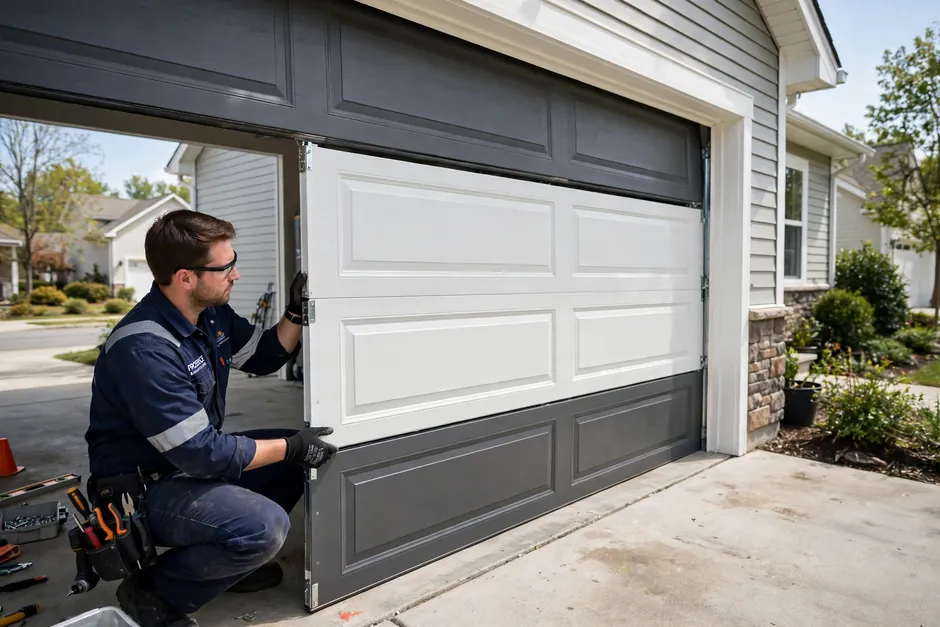
Damage Assessment
We check whether the damage is cosmetic or structural: dented skin versus a creased section that binds in the track. Cosmetic damage gets a panel swap; structural damage gets an honest conversation about the full door.
One or two damaged sections do not have to mean a whole new door. We replace individual panels to match your existing door whenever the match is honest.
We check whether the damage is cosmetic or structural: dented skin versus a creased section that binds in the track. Cosmetic damage gets a panel swap; structural damage gets an honest conversation about the full door.
Section height, width, emboss pattern, and material have to match the existing door. We identify the manufacturer and model from the remaining sections and source the closest true match.
Panel replacement means working with the door's spring tension released safely and the door secured. Hinges, rollers, and struts transfer to the new section and get torqued to spec.
The new section must sit flush and travel without binding through the radius curve. We run full cycles and check the door's balance, since panel weight affects spring tension.
Most repairs land between $129 and $399. You get a clear on-site quote before any work starts.
Call (615) 616-0612 and describe the symptom. We will tell you honestly whether it sounds like a quick fix or a bigger job.
Direct answer: Residential garage door panels, also called sections, are most commonly made from steel, with aluminum, wood, and composite options on some doors. Steel sections come in single-layer (uninsulated), double-layer (insulated backing), and triple-layer (sandwich construction) builds. Replacing one or two damaged sections makes sense when the rest of the door is sound and a matching section is available; when three or more sections are damaged or no match exists, a full door replacement is usually the better value.
Here is how we evaluate it on a job. First the match question, because it decides everything. We need the same manufacturer, the same section height (commonly 21 or 24 inches), the same emboss pattern (raised panel, carriage house, flush), and the same material and insulation build. Even from the same manufacturer, a new section will look slightly brighter than sun-faded neighbors; we say that up front so there are no surprises. If the door is discontinued or the pattern changed, we will tell you a perfect match is not available rather than installing a close-enough section and hoping you do not notice.
Then the structural question. A dented skin that still travels true is a cosmetic swap. A creased section that binds in the track, a bottom section rusted through at the corners, or a section bowed from impact is structural, and it stresses hinges, rollers, and the opener every cycle. Impact damage from vehicles is the top cause we see in Mount Juliet's busy two and three car garages, followed by March-to-May storm debris and, on older steel doors, rust-through where the bottom seal has trapped moisture against the section.
On insulation: if your door has insulated sections, the replacement should match the build, not just the face. A single uninsulated section in an insulated door creates a cold and noise weak point. Insulated sections list an R-value from the manufacturer; we match the construction type so the door performs as one unit.
Panel work starts with an honest match check. If we cannot match it, we will tell you before quoting.
Describe the damage
Call (615) 616-0612. Dented, creased, rusted, storm-hit: a photo helps, but we confirm the match on-site.
Match and structural check
We identify the door's make, model, and section specs, and check whether the damage is cosmetic or structural. No match, no quote for a swap; we discuss the real options.
Clear quote, then the swap
Firm price before work starts. Most panel replacements in Mount Juliet land in the $129 to $399 range per section, depending on material and insulation.
Fit and travel test
New section seated flush, hardware transferred and torqued, full travel cycles run, balance rechecked.
A panel swap is surgery on a tensioned system. Here is the discipline.
Winding bars and clamps
Spring tension gets safely released before sections come apart and restored after. Panel work without controlling the springs is how doors drop mid-job.
Socket set and drivers
Hinges, rollers, struts, and operator brackets transfer from the old section. Every fastener gets torqued; loose hinge bolts are a future noise complaint.
Section supports and sawhorses
Removed sections are heavy and awkward. Proper supports keep them from twisting, which would ruin a reusable section or injure a back.
Level and straightedge
The new section must sit flush with its neighbors. Even a small offset shows as a shadow line and can catch at the radius curve.
Tension off, door secured
We release spring tension and clamp the door before separating sections. This is the step that separates professional panel work from dangerous improvisation.
Hardware transfer audit
Hinges, rollers, struts, and brackets move to the new section. Worn pieces get flagged; a new section on tired hinges is a false economy.
Weight-match check
A new section that weighs differently from the old one changes the door's balance. We recheck balance after the swap and adjust spring tension if needed.
Seal and finish check
Bottom seal and section joints get inspected. A new bottom section is the right time to replace a rotted seal, since it is already in hand.
Three scenarios where replacing sections beats replacing the door.
Scenario 01
The situation: the classic garage mishap. One bottom section dented or creased, the rest of the door straight and sound, hardware healthy.
What we do: source a matching bottom section, swap it with hardware transferred, and replace the bottom seal while we are there. Do not keep running a creased section; it binds and stresses everything.
Scenario 02
The situation: March-to-May storms throw branches. A dented but uncreased section looks bad and can catch wind-driven rain at the joint.
What we do: if the section still travels true, a cosmetic swap restores the look and the weather seal. We match the emboss pattern so the repair disappears.
Scenario 03
The situation: older steel doors where the bottom seal trapped moisture against the section. Paint bubbles, then pinholes, then the corner crumbles.
What we do: replace the rotted section and the seal together, and check the next section up. If rust has climbed, we will show you and discuss whether the door is worth saving.
Curb appeal matters here, and the garage door is a big part of the facade. Providence townhomes, Triple Crown's carriage-house styles, and Willoughby Station's traditional raised panels each need their own match, which is why we identify the door before promising anything.
Typical panel calls, what we found, and what fixed it.
Damage type on the left, what it means on the right.
Problem
Cosmetic damage from a light impact. Ugly, but the section is structurally sound and the door runs normally.
Our Fix
A straightforward section swap to a matching panel. Quick, clean, and far cheaper than a new door.
Problem
Structural damage. The section catches at the radius curve, stresses hinges and rollers, and makes the opener work harder every cycle.
Our Fix
Replace the section before the binding damages the track and opener. We check the neighboring sections for transferred stress while we are in there.
Problem
Moisture trapped by the bottom seal eats steel sections from the corners inward. Filler and paint only hide it temporarily.
Our Fix
Replace the rotted section and the seal together. If rust has climbed into the next section, we show you and give you the full-door math honestly.
One or two sections cost far less than a full door. When the rest of the door is sound, a swap is the obvious value.
The garage door dominates the facade on most Mount Juliet homes. One clean section brings the whole front back.
A binding section stresses hinges, rollers, tracks, and the opener. Replacing it protects everything around it.
Matching the section's insulation build keeps the door's thermal and noise performance uniform, no weak panel.
Most single panel replacements in Mount Juliet land between $129 and $399 per section, depending on the material, insulation build, and whether hardware transfers cleanly. Two sections cost more than one but far less than a new door.
If the match is not available or three or more sections are damaged, we will show you the full-door math instead of selling you a patchwork.
Panel work is where honesty about matching matters most.
We identify the door's make, model, and section specs first. If a true match does not exist, you hear it before any price.
A new section next to sun-faded ones will read slightly brighter. We say so before you approve, not after it is installed.
Three damaged sections or no available match, and we will lay out the replacement-door numbers next to the patchwork cost.
New sections can weigh differently. We verify door balance after every swap and adjust spring tension if needed.
No hype. Just the visit, step by step.
If the damaged section catches in the track, stop using the door. Forcing it bends the track and multiplies the repair.
We confirm the match, assess the structure, and price the swap. Most single sections fall between $129 and $399.
Tension released safely, hardware transferred and torqued, old section and debris taken with us.
The new section sits flush with its neighbors and runs full quiet cycles before we leave.
Straight answers to the questions Mount Juliet homeowners ask us most. Still unsure? (615) 616-0612, talk to a real person.
Yes, when the rest of the door is sound and a matching section is available. One or two damaged sections are the sweet spot for panel replacement. When three or more sections are damaged, or no match exists for a discontinued door, a full replacement is usually the better value, and we'll show you that math.
We match the manufacturer, section height, emboss pattern, material, and insulation build. One honest caveat: a brand-new section looks slightly brighter next to sun-faded neighbors. We disclose that before you approve the work so there are no surprises.
It depends on the damage type. A dented skin that travels true is cosmetic and your call. A creased section that binds in the track, or a bottom section rusted through at the corners, is structural: it stresses hinges, rollers, and the opener every cycle and should be replaced.
It shouldn't, as long as the replacement matches the door's construction. We match the insulation build, not just the face, so an insulated door doesn't end up with one uninsulated weak point that leaks heat and noise.
Garage door parts work as a system. These are the repairs most often paired with this one.
When three sections are gone or no match exists, a new door is the honest answer.
Impact panel damage often comes with a derailment. We handle both.
A binding section can bend track. We straighten or replace damaged sections.
Panel swaps are the right time to assess rollers and hinges.
A binding panel strains the opener. We verify force settings after the swap.
Storm damage that won't wait? The emergency line runs 24/7.
Tell us what your garage door is doing, or not doing. We serve Mount Juliet and the surrounding Wilson County area, Mon–Fri 7AM–7PM and Sat 8AM–4PM, with an emergency line for Sunday and after-hours calls.
Phone
(615) 616-0612
Address
121 Adams Ln, Mount Juliet, TN 37122
Hours
Mon–Fri: 7AM–7PM
Sat: 8AM–4PM
Sun: emergency only · 24/7 emergency line