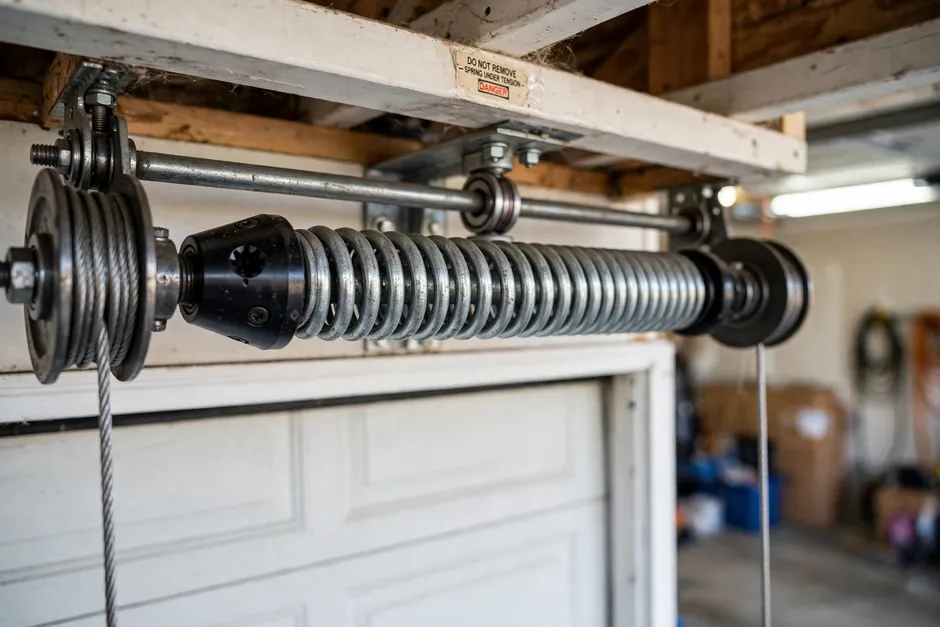
Spring Identification
Torsion springs mount on a shaft above the door; extension springs run alongside the horizontal tracks. We identify your type, wire size, and length so the replacement matches the door's weight, not just its looks.
Springs are the most dangerous part of your garage door system. This is pro-only work, and we treat it that way: correct spring type, matched pair, proper tension, full safety check.
Torsion springs mount on a shaft above the door; extension springs run alongside the horizontal tracks. We identify your type, wire size, and length so the replacement matches the door's weight, not just its looks.
Springs are rated for a cycle life, commonly around 10,000 open-close cycles. Both springs on a door age together, so we replace them as a pair. Replacing one leaves you paying for a second visit months later.
New springs get wound to the correct number of turns for your door height and weight, then we verify balance: the door should hold steady at waist height with the opener disconnected.
A broken spring often damages cables and drums on its way out. We inspect both, plus center bearings and end plates, and flag anything worn before it becomes the next failure.
Most repairs land between $129 and $399. You get a clear on-site quote before any work starts.
Call (615) 616-0612 and describe the symptom. We will tell you honestly whether it sounds like a quick fix or a bigger job.
Direct answer: Most modern residential doors use torsion springs: thick coils mounted on a steel shaft above the door opening that twist to store energy and counterbalance the door's weight. Older or lighter doors may use extension springs, which stretch along the horizontal tracks on each side. Torsion systems are smoother, more durable, and safer when they fail, which is why they are standard on most Mount Juliet homes built in the last 20 years.
Here is the technician's view. A standard double-car garage door weighs 150 to 250 pounds or more. You do not lift that weight; the springs do, by storing energy as the door closes and releasing it as the door opens. The opener just guides the motion. When a spring breaks, usually with a bang loud enough to hear across the house, the door becomes dead weight. Running the opener against that weight will strip gears or burn out the motor fast, so stop using it.
Spring steel fatigues with every cycle, and standard springs are rated around 10,000 cycles. A door used four times a day hits that in about seven years. Add Wilson County's climate: humid summers pit the steel with surface corrosion, creating stress points, and winter cold snaps make the steel contract and turn brittle. Weak springs love to snap on the first hard freeze, which is exactly what happened to plenty of doors during the January 2026 ice storm that left Middle Tennessee garage doors frozen and dead.
This is also why the repair community's consensus is so firm: springs are not a DIY job. A wound torsion spring holds enough energy to cause serious injury if a winding bar slips. We carry the right bars, clamps, and new matched springs on the truck, and we tension to the door's actual weight, not a guess.
Spring calls get priority handling because a door with a broken spring is a door you cannot use safely.
Describe the symptom
Call (615) 616-0612. Loud bang, door crooked, opener humming but the door barely moves: we will know what to bring.
Safe the door
We secure the door in place first, then inspect springs, cables, drums, and bearings. You will see the broken coil with your own eyes before we quote.
Clear quote, then the swap
Firm price before work starts. Most spring replacements in Mount Juliet land in the $129 to $399 range. Then we replace the pair and tension to spec.
Balance and safety test
Door holds at waist height with the opener disconnected, cables sit true on the drums, full travel cycles run smooth and quiet.
Spring work has zero margin for improvised tools. Here is the proper kit.
Winding bars (proper diameter)
Solid steel bars sized to the winding cone, used in pairs. Screwdrivers are not winding bars; a slipped bar under full spring tension is how injuries happen.
Vise grips and C-clamps
Lock the torsion shaft and clamp the tracks so nothing moves while old springs come off and new ones go on.
Spring sizing calipers and charts
Wire diameter, coil length, and inside diameter determine the spring's lifting power. We measure and match to the door's weight, which is why we weigh or spec the door rather than eyeballing it.
Ladder and headlamp
Torsion hardware lives above the opening in dim garage light. Solid footing and visibility are non-negotiable when tensioning.
Matched-pair replacement
Both springs share the same cycle count, so both are at end of life together. Replacing the pair keeps the door balanced and avoids a second service call within months.
Turn-count tensioning
Torsion springs are wound a set number of quarter-turns based on door height, commonly around 30 quarter-turns for a 7-foot door. Under-wound springs make the opener strain; over-wound springs slam the door up.
Cable and drum inspection
We check that lift cables wind evenly on the drums with no overlap or fraying, and that drums, center bearings, and end bearing plates are sound.
Balance verification
Opener disconnected, door lifted to waist height, released. It should stay. Then full powered cycles to confirm smooth, quiet travel end to end.
Springs rarely fail without warning. Here is what to watch for.
Sign 01
What happened: a spring snapped under tension. You may see a visible gap in the coil above the door, or the door sitting crooked.
What we do: secure the door, replace the spring pair, re-tension, and check cables and drums for collateral damage.
Sign 02
What happened: weak or partially failed springs cannot counterbalance the door, so the opener's force limit trips or gravity wins.
What we do: test balance with the opener disconnected to confirm, then replace the pair before the opener burns out trying to compensate.
Sign 03
What happened: a spring let go on one side, so that side's cable went slack and jumped the drum. The door is now hanging crooked and unsafe.
What we do: do not run the door. We reset the cables on the drums, replace the springs, and re-tension the whole assembly as a unit.
Where a home sits in Mount Juliet tells us a lot about its springs. Mid-2000s builds are hitting the age where original 10,000-cycle springs give out, and the January 2026 ice storm showed how fast a cold snap finishes off weakened steel.
Typical spring calls, what we found, and what fixed it.
A broken spring is never just a broken spring. Here is the damage chain.
Problem
Without spring counterbalance, the opener tries to lift 150-plus pounds. Gears strip, motors overheat, and the door can slam down without warning.
Our Fix
We replace the spring pair and tension to the door's weight, then verify the opener is no longer doing the springs' job. If the opener was damaged in the meantime, we tell you before quoting the extra work.
Problem
When one spring fails, that side loses tension, the cable goes slack, and it can wind off the drum. The door racks sideways and binds in the tracks.
Our Fix
Springs and cables get serviced together: new matched springs, cables inspected for kinks and re-seated true on the drums, door squared and travel-tested.
Problem
Weak springs let the door drop the last foot and bounce on close, hammering rollers, hinges, and the bottom seal. Everything downstream wears faster.
Our Fix
Correct tensioning restores the gentle close. While we are there we check rollers and hinges for the wear the bad springs caused, and quote honestly if anything else needs attention.
A door with a broken spring can drop without warning, and a wound torsion spring stores serious energy. This is the one repair where calling a pro is not optional advice; it is the consensus of everyone who has seen one let go.
Every cycle on weak springs grinds the opener's gears and overheats the motor. Fresh springs return the opener to guiding the door instead of lifting it, which is what it was built for.
Replacing the pair costs little more than replacing one and resets the clock on the whole counterbalance system. No second bang six months from now.
Correctly tensioned springs make the door feel nearly weightless by hand. The banging, bouncing, and straining all stop at once.
Most broken spring replacements in Mount Juliet land between $129 and $399. That covers a matched spring pair, tensioning, and the balance test. You approve the price on-site before we start, which is exactly what homeowners in those price-fairness debates online keep asking for: a number you can see before the work begins.
If cables or drums were damaged when the spring let go, we quote that cable work separately and up front, never as a surprise.
Spring work earns trust through competence, not credentials we cannot show you. Here is our standard.
We point out the snapped coil, the fatigue cracks, the frayed cable, before quoting. You should never have to take our word for it.
Springs get sized to your door's weight and height from measurements, not from whatever happens to be on the shelf.
Extension springs get containment safety cables as standard practice. If your old setup lacks them, we add them.
The waist-height hold test happens in front of you. If the door does not hold, the job is not done.
No hype. Just the visit, step by step.
Until we arrive, leave a broken-spring door alone. Forcing it risks the cables, the tracks, and the opener.
We inspect, show you the failure, and price the pair before starting. Most spring jobs fall between $129 and $399.
Shaft locked, tracks clamped, proper winding bars. Old springs leave with us.
You will watch the door hold at waist height with the opener disconnected, then run full quiet cycles before we pack up.
Straight answers to the questions Mount Juliet homeowners ask us most. Still unsure? (615) 616-0612, talk to a real person.
Most spring replacements in Mount Juliet land between $129 and $399 for a matched pair, tensioned and balance-tested. The exact number depends on torsion versus extension type and the door's weight and height. We inspect on-site and give you a firm price before starting, which is exactly the transparency homeowners keep asking for online.
Yes. Both springs on a door share the same cycle count, so when one reaches the end of its fatigue life, the other is right behind it. Replacing the pair costs little more than replacing one, keeps the door balanced, and saves you a second service call a few months later.
Look above the door opening. A thick coil mounted horizontally on a steel shaft is a torsion spring; it twists to store energy. Two long springs running alongside the horizontal tracks on each side are extension springs; they stretch. Most Mount Juliet homes built in the last 20 years use torsion systems.
Cold makes spring steel contract and more brittle, so a spring already near the end of its cycle life often snaps on the first hard freeze. The January 2026 ice storm finished off weakened springs across Middle Tennessee. If your door groans or strains on cold mornings, have the springs checked before the next freeze.
Standard torsion springs are rated around 10,000 open-close cycles. A door used four times a day reaches that in roughly seven years. Heavier insulated doors, high daily use, and humid summers that corrode the steel all shorten that life.
Garage door parts work as a system. These are the repairs most often paired with this one.
A snapped spring often takes cables and drums with it. We service them together.
Weak springs burn out opener motors and strip gears. We check the opener after every spring job.
Bad springs hammer rollers and hinges. We check for the wear they caused.
A door that racked when the spring failed may need track realignment too.
Spring failures are a top cause of derailed doors. Reseat plus root cause.
Door stuck at the worst hour? The emergency line runs 24/7.
Tell us what your garage door is doing, or not doing. We serve Mount Juliet and the surrounding Wilson County area, Mon–Fri 7AM–7PM and Sat 8AM–4PM, with an emergency line for Sunday and after-hours calls.
Phone
(615) 616-0612
Address
121 Adams Ln, Mount Juliet, TN 37122
Hours
Mon–Fri: 7AM–7PM
Sat: 8AM–4PM
Sun: emergency only · 24/7 emergency line