Garage doors are supposed to be boring to listen to. When yours starts grinding, squeaking, or banging, each sound is a diagnostic clue. This is the same noise map we use on service calls across Mount Juliet, from Stonehollow's mid-2000s builds running on original hardware to Willoughby Station's 1990s and 2000s brick homes.
The noise map: what each sound means
A garage door has a small vocabulary. Learn it once:
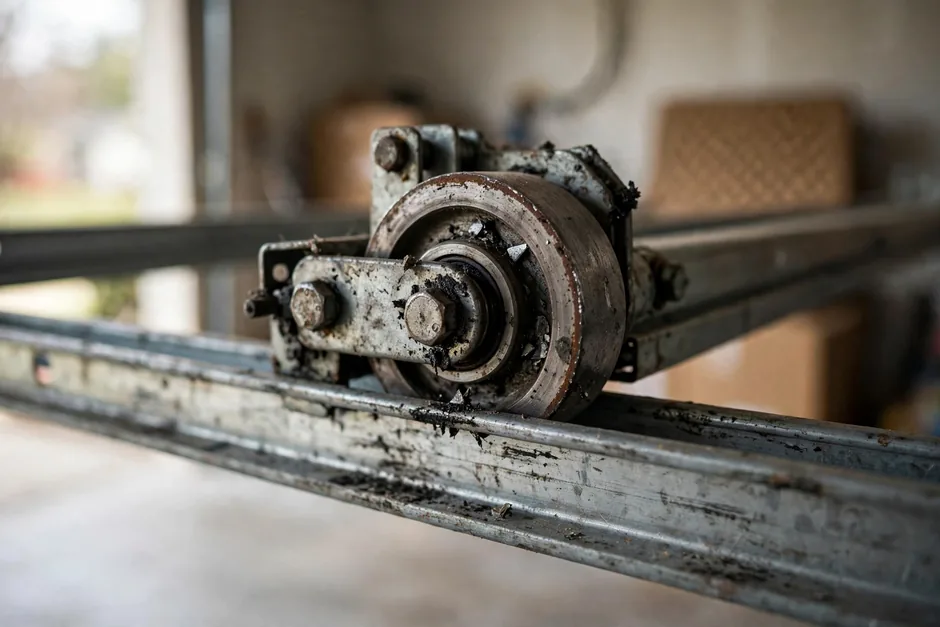
- Grinding or scraping. Worn rollers. Steel rollers develop flat spots and their bearings seize, and you hear it as metal dragging in the track.
- Squeaking or screeching. Dry metal on metal. Hinges, roller bearings, and springs asking for lubrication.
- Banging or slamming. The door hitting too hard, or the unmistakable bang of a spring breaking followed by a door that will not lift.
- Rattling. Loose hardware. Thousands of open and close cycles vibrate nuts and bolts loose on hinges, track brackets, and the opener mount.
- Popping. Torsion spring coils binding and releasing as they wind, or a worn spring nearing the end of its life.
Grinding: worn rollers
Grinding that tracks the door's movement almost always means the rollers. As steel rollers wear, they stop rolling smoothly and start dragging, and the sound gets louder as the wear gets worse. Nylon rollers with sealed bearings run noticeably quieter and are the common upgrade when noise is the complaint.
One safety rule: do not touch the bottom roller bracket yourself. It carries spring tension, and releasing it the wrong way can cause serious injury. Roller replacement is quick work for a technician and includes that bracket done safely. See roller replacement.
Squeaking: dry hardware
Squeaks and screeches are the friendliest noise on this list. They mean metal is moving against metal without lubrication. Apply a silicone-based or white-lithium garage-door lubricant to the hinges, roller bearings, and springs every 3 to 6 months, and the noise usually disappears the same day.
Wilson County's humid summers accelerate surface corrosion on bare steel hardware, which is why a door that was quiet in spring can start squeaking by August. A fall lubrication round carries the door into winter in good shape. Skip heavy grease: it collects grit and makes the problem worse over time.
Banging and popping: springs and travel limits
A popping sound from above the door on the way up is often the torsion spring's coils shifting as they wind. A single loud bang followed by a door the opener cannot lift is the classic signature of a spring breaking. If you hear that bang, do not keep running the opener; you will only strain it.
A door that slams shut instead of easing down usually has drifted travel or force settings, or a spring that is no longer carrying its share of the weight. Either way, a slamming door wears out the opener faster and deserves attention before the extra stress breaks something else.
Rattling: loose hardware
Rattling is vibration made audible. With the door closed, you can safely snug the bolts on the hinges and track brackets with a socket wrench; leave all spring hardware strictly alone. If the rattle is coming from above, check the opener's mounting. A chain-drive opener bolted rigidly to the ceiling joists transmits every vibration into the house, which matters a lot when there is a bedroom above the garage. Rubber isolation at the mount quiets it considerably.
When the opener itself is the noise
Sometimes the door is fine and the opener is the loud one. Chain drives are the loudest of the common drive types, belt drives the quietest, with screw drives in between. If your opener is old, loud, and mounted without any vibration isolation, the fix may be adjustment and isolation, or it may be time to discuss replacement. A technician can tell you which makes sense after hearing it run. See opener repair.
Noises that mean call now
Call right away if you hear a loud bang and the door will not open, if grinding suddenly gets much worse, which can mean a roller or track failure with the door going off track, or if any noise comes with a crooked door or a hanging cable. See track repair for what off-track damage involves.
We quiet down noisy doors across Stonehollow, Willoughby Station, and the rest of Mount Juliet. If the noise started suddenly or the door looks wrong, our 24/7 emergency line is the fastest way to reach us.
Quiet down that garage door
Grinding, squeaking, banging, or rattling, call (615) 616-0612 and describe the sound. We will tell you what it likely is and what it takes to fix it.