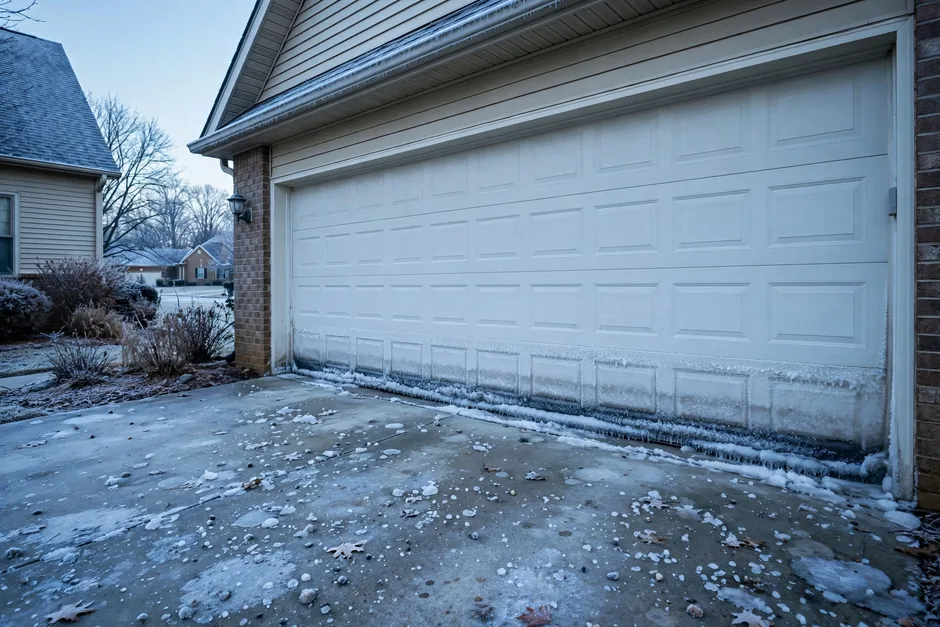
Middle Tennessee does not stay cold for long, but its cold snaps are sharp: ice storms, sleet, and nights well below freezing. Those few days produce a predictable wave of garage door failures across Mount Juliet. This guide covers the three big ones, plus the power-outage scenario, in the order you are most likely to meet them.
When the door freezes to the ground
Meltwater under the bottom seal refreezes overnight and glues the door to the concrete. In the morning the opener hums, strains, and either reverses or trips its overload. This is the most common Tennessee winter garage door emergency call there is.
Do not keep hitting the button. Repeated tries can strip the opener's gears or burn out the motor. Break the ice at the seal gently and clear it fully before running the door. Skip the hot water: it refreezes fast, risks damaging the seal and the concrete, and the sudden temperature swing can crack paint.
Prevention is a two-minute job in fall: a light coat of silicone spray on the bottom seal, and making sure driveway water drains away from the door instead of pooling against it.
When the opener struggles in the cold
Grease thickens as temperatures drop, so every moving part resists more and the opener works harder. An older opener running on heavy, dried-out grease may barely lift the door on a freezing morning.
What helps: fresh silicone-based lubricant on the hinges and roller bearings before winter, rated for cold weather. What does not help: cranking up the force setting to compensate. If the door still will not move after lubrication, check for a frozen seal or a broken spring before blaming the opener. A technician can verify the force and travel settings are correct for winter operation. See opener service.
When a spring snaps in a freeze
Spring steel contracts in freezing temperatures, and a spring already near the end of its cycle life often lets go on the coldest night of the year. The signature is unmistakable: a loud bang from the garage, then a door the opener cannot lift.
Confirm it safely: disconnect the opener with the release cord and try lifting the door by hand. If it is dead-weight heavy or will not stay open, the spring is done. Stop there. Do not try to force it, prop it, or drive under it. See broken spring replacement.
Power outages: using the emergency release
Ice storms take down power, and a dead opener means a door that will not move on its own. Pull the red emergency release cord to disengage the trolley, then lift the door manually. When power returns, pull the cord back toward the door and run the opener once to re-engage.
The critical check comes before you lift: if the door feels very heavy or will not stay up on its own, stop immediately. That means a spring is broken, and a heavy manual door can slam down without warning. During the January 2026 ice storm, some Middle Tennessee families found their garage-stored tools unreachable behind a dead opener and a frozen door. Know where your release cord is before the storm, not during it.
Getting ahead of the next cold snap
Every item in this guide is easier in fall than in January: fresh lubrication, an intact seal, a balance test, and a release cord you have actually tested once. Our fall maintenance checklist walks through all of it step by step.
And when a cold snap wins anyway, you are not stuck. We run emergency garage door service across Willoughby Station, Langford Farms, and the rest of Mount Juliet, with a 24/7 emergency line for nights like these.
Stuck in a cold snap?
Frozen seal, dead opener, or a spring that let go overnight: call (615) 616-0612. Our 24/7 emergency line exists for exactly these nights.